
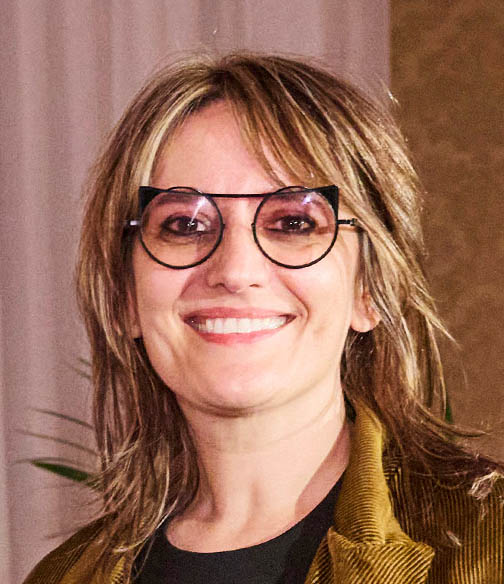
Silvia Alessi, Italy
Born in Bergamo, Italy, Silvia Alessi discovered reportage photography during a trip to Asia and has since traveled extensively, pursuing her passion for “telling stories worthy of being told.” Her artistic process blends reportage with an openness to diverse cultures, resulting in award-winning projects like “Skin” (India), “Beyond the Line” (Iraqi Kurdistan), and “Maze of Metamorphosis” (Japan). Before each project, she conducts extensive research to understand the social context and develop a visual language that effectively conveys her concept.
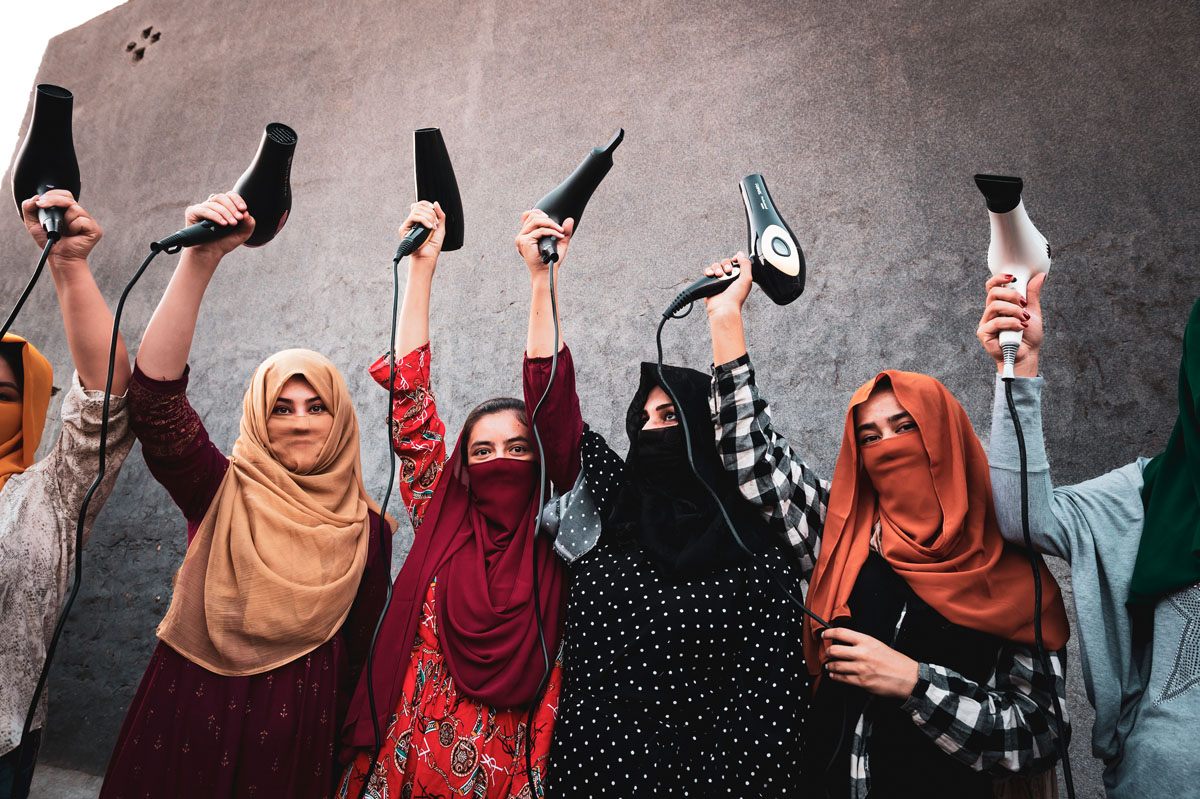
Even the hairdryer is a form of liberation!
In a single photograph, the Italian photographer Silvia Alessi has captured the rebellion against the oppression of women, a moment of liberation and the longing to be at peace with life. These are women who have fled from Afghanistan to Pakistan, each of whom is here defiantly and confidently holding a hairdryer aloft.
Amongst many other things, the radical Islamist and ultra-reactionary Taliban, who have been in power in Afghanistan since August 2021, have also banned beauty salons for women. What was once one of the few professions in which Afghan women could still work is now illegal, like so many other things for women. Even though their hair must be concealed beneath headscarves anyway.
What has been eradicated in Afghanistan – what cannot be practised or learnt there – young women who have fled are now mastering in Pakistan. In classrooms equipped with mirrors, hairdressing tools and mannequins. Every hairdryer is a weapon in the struggle for self-determination, identity and visibility, for participation and the right to choose a profession.
These women are not making peace with the Taliban, but they are certainly making peace with their own aspirations. Are there more important battlegrounds in the fight for women’s rights than, of all places, the hairdressing salon: the schools, the universities, the doctors’ surgeries? There are plenty. And yet what Silvia Alessi has uncovered here is anything but trivial. Rather, it is a small beacon of hope! For this is about women’s bodies, over which, according to Taliban ideology, men are meant to rule.
But if Alessi has chosen to focus on a desire for beauty forced into exile of all things, this also has to do with her own life story. Born in Brescia, northern Italy, in 1975, the photographer worked as a hairstylist herself for over ten years before discovering her interest in photojournalism during a trip to Asia in 2004. Since then, she has worked in Japan, India and Iraq, amongst other places, and has had her work published in all the major European countries, as well as in Israel and the Philippines. She has also won several awards in photography competitions. Peace, says Alessi, is anything but an abstract concept for the women she photographs. They hold a tool for self-empowerment in their hands.
(Laudatio by Peter-Matthias Gaede)