
Mahdi Vaghari, Iran
Mahdi Vaghari travels with a film and a stills camera and has taken part in several photography competitions that are still little known in Europe. In a competition in Russia, he won second prize in the “Humans and Nature” category; in Poland, one of his pictures won a competition for “Humour and Satire”. His photographs have been exhibited in Tajikistan and Afghanistan. Vienna is now likely to be the highlight of his career as a photographer so far.
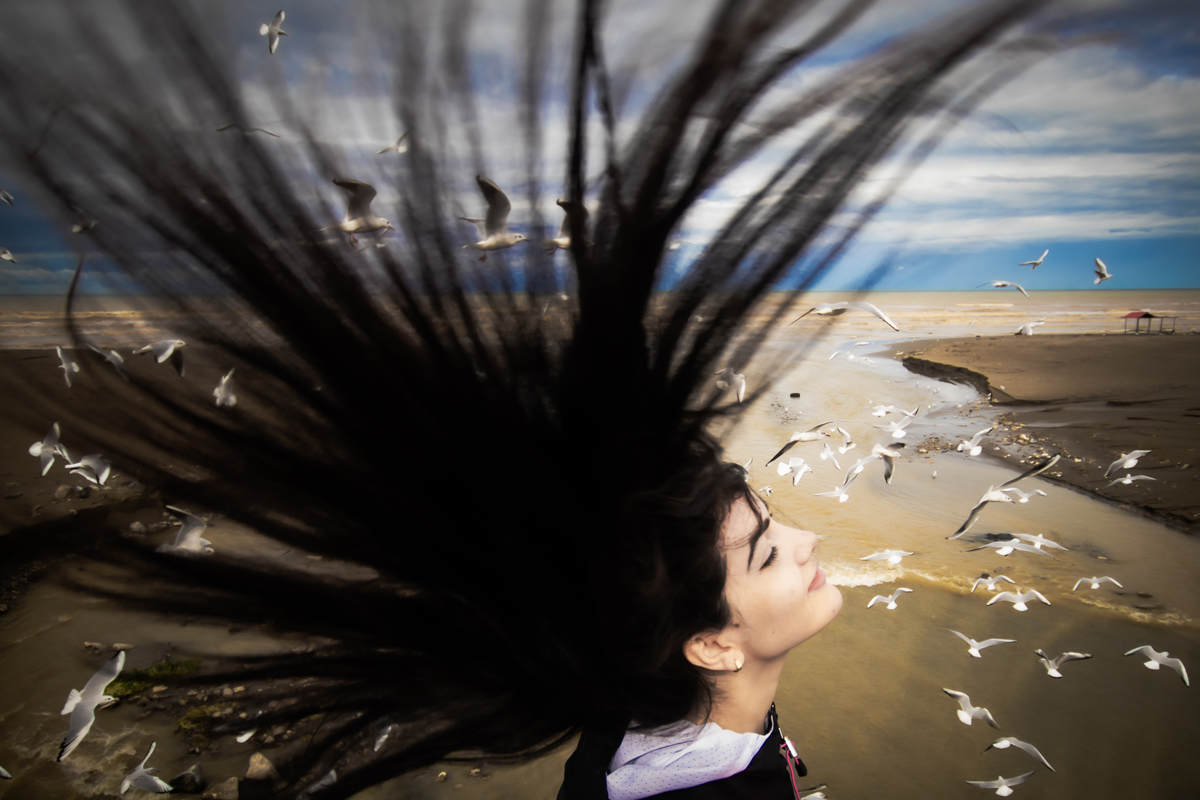
And yet another Iranian woman. And yet another woman without a hijab. No veiling, no hiding. No modesty, no sadness. Rather, pride in what a woman is not supposed to show, lest she provoke the men. A gust of wind has whipped this young Iranian woman’s magnificent hair into a wild crown. She is walking across a bridge, whilst a flock of birds flies over the nearby beach. Freedom on two levels.
An image of great power that actually – unlike so many photos – needs no words at all. The mere fact that it was taken in Iran gives it, once again, a special significance. It was taken by a man who is not yet well known in our part of the world: Mahdi Vaghari, born in Iran in 1995, who began taking an interest in photography in 2003 and was taught by his father.
Anyone working as a photographer in Iran certainly faces very different conditions than photojournalists here. First and foremost, a different understanding of the role of the media. Perhaps also a different way of talking about photography. So, if it is not to become a direct confrontation with the official image a country is supposed to project, it must, in a sense, be conveyed through translation, often veiled in art projects. Through allusions. Through symbolism. Open to interpretation. And yet, at the same time, clear.
We don’t know whether all this was on Madhi Vaghari’s mind. He saw the stranger during a break near the Caspian Sea; he asked her – “politely”, as he emphasises – if he might take her photograph. Because the wind in her hair, the whole scene, made him think of “freedom and liberation”. It was that simple. That clear. “Nobody,” he captioned his photo, as if the woman were speaking herself, “can own my soul.”
“I want to capture ‘authentic emotions’,” says Mahdi Vaghari. And he does so in the hope of drawing attention to everything that could make the world a more beautiful place. A more peaceful one.
(Laudatio by Peter-Matthias Gaede)